Poco means “little,” “few,” or “somewhat.” It comes from Italian and traces back to the Latin word paucus, meaning “small in number.”
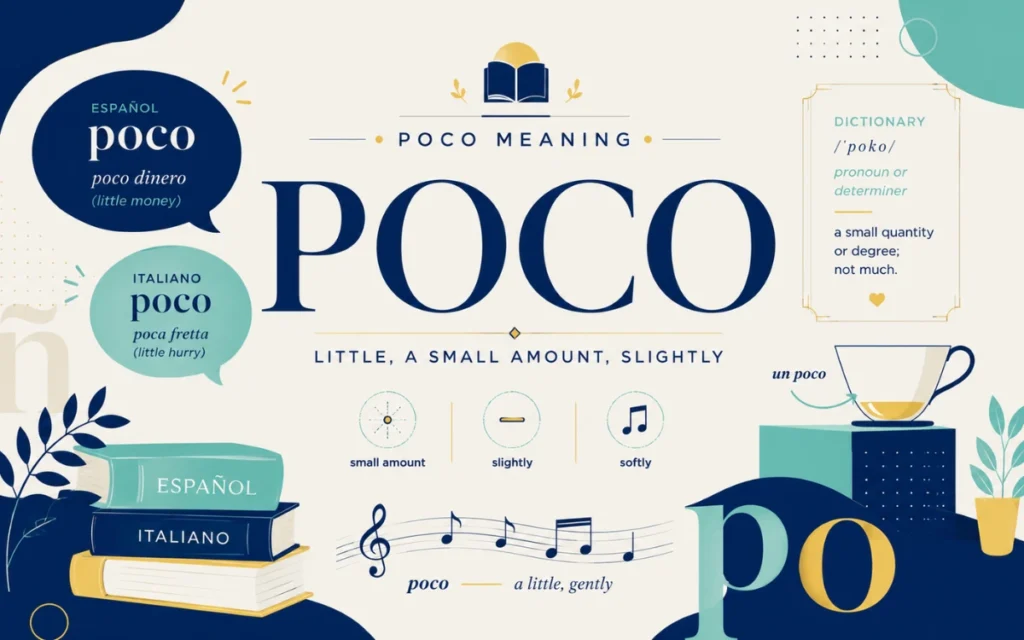
The word shows up in Spanish, Italian, and even classical music — and its meaning shifts slightly depending on where you hear it.
What Does Poco Mean?
At its core, poco meaning points to limitation. It describes a small quantity, a slight degree, or a reduced intensity — never abundance.
The word is Italian in origin, borrowed by Spanish and used worldwide in musical notation.
Poco Meaning in English
It shows up mostly in musical instructions and academic writing, where it means “slightly” or “a small amount.”
Poco Meaning in Spanish
In Spanish, poco works as both an adjective and an adverb. As an adjective, it agrees with the noun’s gender and number: poco, poca, pocos, pocas.
- Tengo poco tiempo. – I have little time.
- Pocas personas llegaron. – Few people arrived.
As an adverb, poco stays fixed and follows a verb: Duermo poco (I sleep little).
Poco vs. Un Poco vs. ¿A Poco
Poco means “little” — a shortage. Un poco means “a little” — a small but real amount. ¿A poco? means something completely different: “Really?” or “No way!” It’s a Mexican expression of surprise and disbelief, not a quantity word at all.
| Expression | Meaning | Example |
|---|---|---|
| poco meaning | little / not much | Tengo poco dinero. |
| un poco meaning | a little | Quiero un poco de café. |
| ¿a poco? meaning | really? / no way! | ¿A poco ya es viernes? |
¿A poco? is heard constantly across Mexico, less often in the rest of Latin America, and rarely in Spain, where speakers prefer ¿en serio? or ¿de verdad? instead.
Common Spanish Expressions With Poco
Spanish speakers build several everyday phrases around this root word.
- Poco a poco – little by little, step by step
- Por poco – almost, nearly (Por poco me caigo — I almost fell)
- Al poco (tiempo) – shortly after
- Poquito – a tiny bit, common when describing food portions
Por poco is one of the most useful of these phrases, yet it’s rarely explained in beginner guides — worth remembering if you want to sound natural.
Poco Meaning in Italian
Italian uses poco almost identically to Spanish, with matching gender and number forms: poco, poca, pochi, poche.
- Ho poco tempo. – I have little time.
- Ci sono poche persone. – There are few people.
Italians also shorten poco into un po’ — note the apostrophe. Drop it, and you’re accidentally referring to the Po River in northern Italy instead of a small amount.
Poco Meaning in Music
In sheet music, poco is a modifier — a word that softens another instruction rather than standing alone. It tells a performer to adjust slightly, not dramatically.
- Poco allegro – a little fast
- Poco forte – a little loud
- Poco ritardando – slow down slightly
- Poco a poco crescendo – increase volume gradually
Italian became the standard language for classical music terms centuries ago, which is why poco still appears on sheet music written in English, French, or German today.
FAQs About Poco Meaning
What does poco mean in Spanish?
Poco means “little,” “few,” or “not much” in Spanish. It changes form to match the noun’s gender and number.
What does poco mean in Italian?
In Italian, poco carries the same core meaning — a small quantity or degree — with forms like poco, poca, pochi, and poche.
What does poco mean in music?
In music, poco tells a performer to make a slight adjustment, such as playing a little faster or softer, without a dramatic shift.
What is the difference between poco and un poco?
Poco signals scarcity (“little”), while un poco signals a small but present amount (“a little”). They are not interchangeable.
What does ¿a poco? mean?
¿A poco? is a Mexican Spanish expression meaning “Really?” or “No way!” It expresses surprise, not quantity.
What does poco a poco mean?
Poco a poco means “little by little” or “step by step.” It describes gradual progress over time.
What is the opposite of poco?
The opposite of poco is mucho in Spanish and molto in Italian — both meaning “a lot” or “much.”